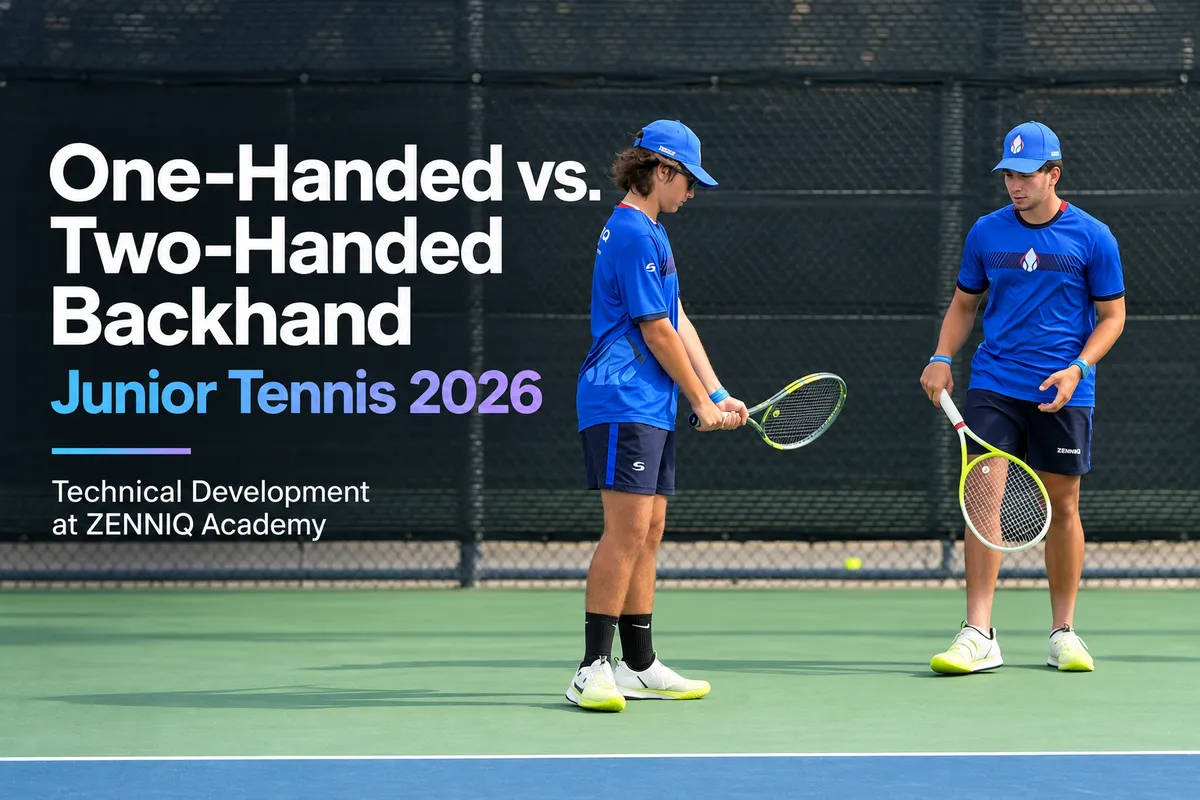
One-Handed vs. Two-Handed Backhand | Junior Tennis 2026
Tennis Backhand Technique, Junior Tennis Development, Junior Tennis Katy TX, Tennis Academy Katy Texas
Is the One-Handed Backhand Disappearing? What Junior Tennis Players Should Learn in 2026
Parents of competitive juniors in Katy, Texas and Greater Houston are hearing a lot of mixed messages about the one-handed backhand and the two-handed backhand. Some say the one-hander is “dead.” Others insist it is the only way to play attacking tennis. The reality in 2026 is more balanced: the best backhand for a junior is the one that fits their body, movement, style, and long-term development – not a trend on social media or a favorite professional player.
What Is a One-Handed Backhand?
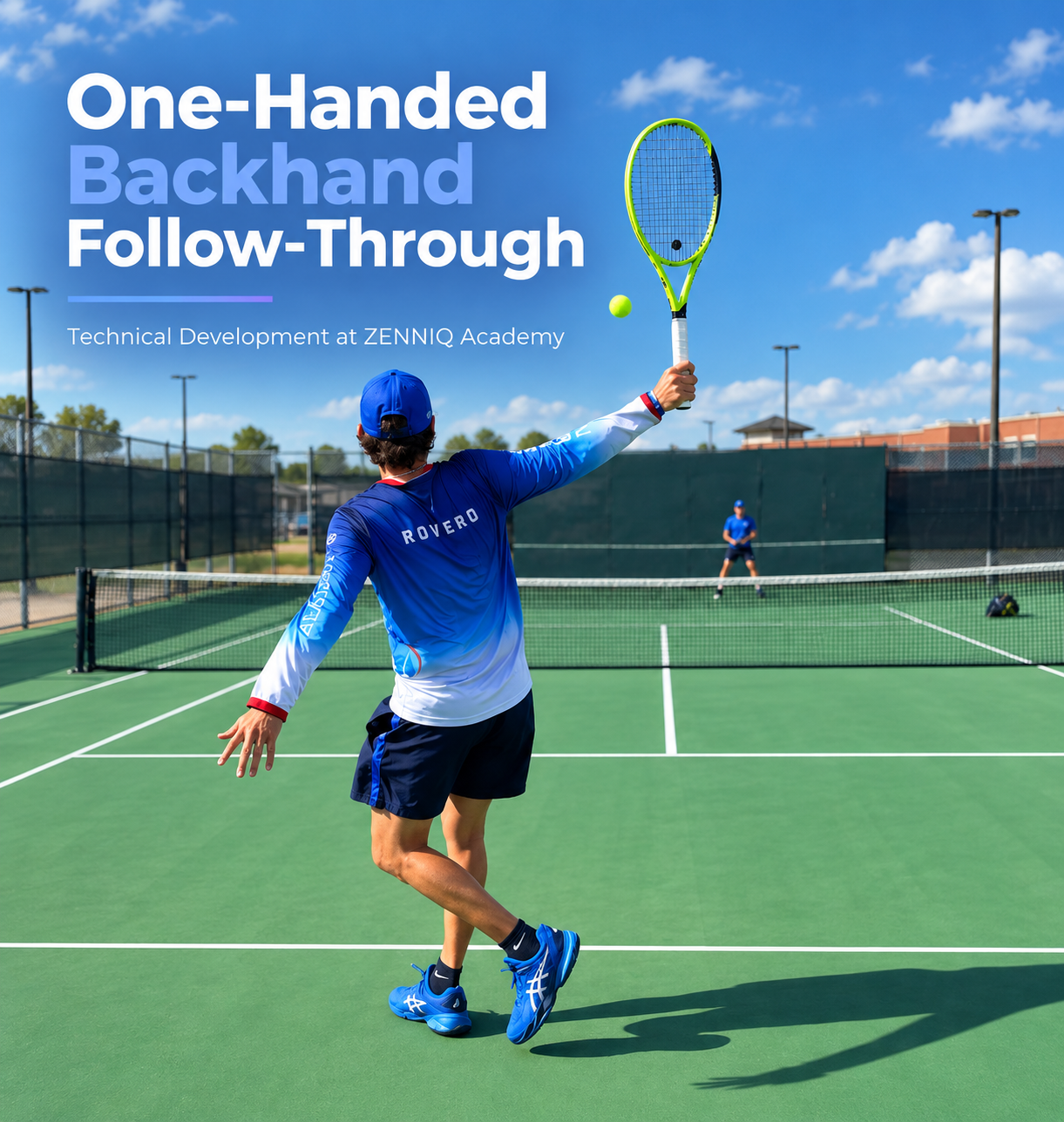
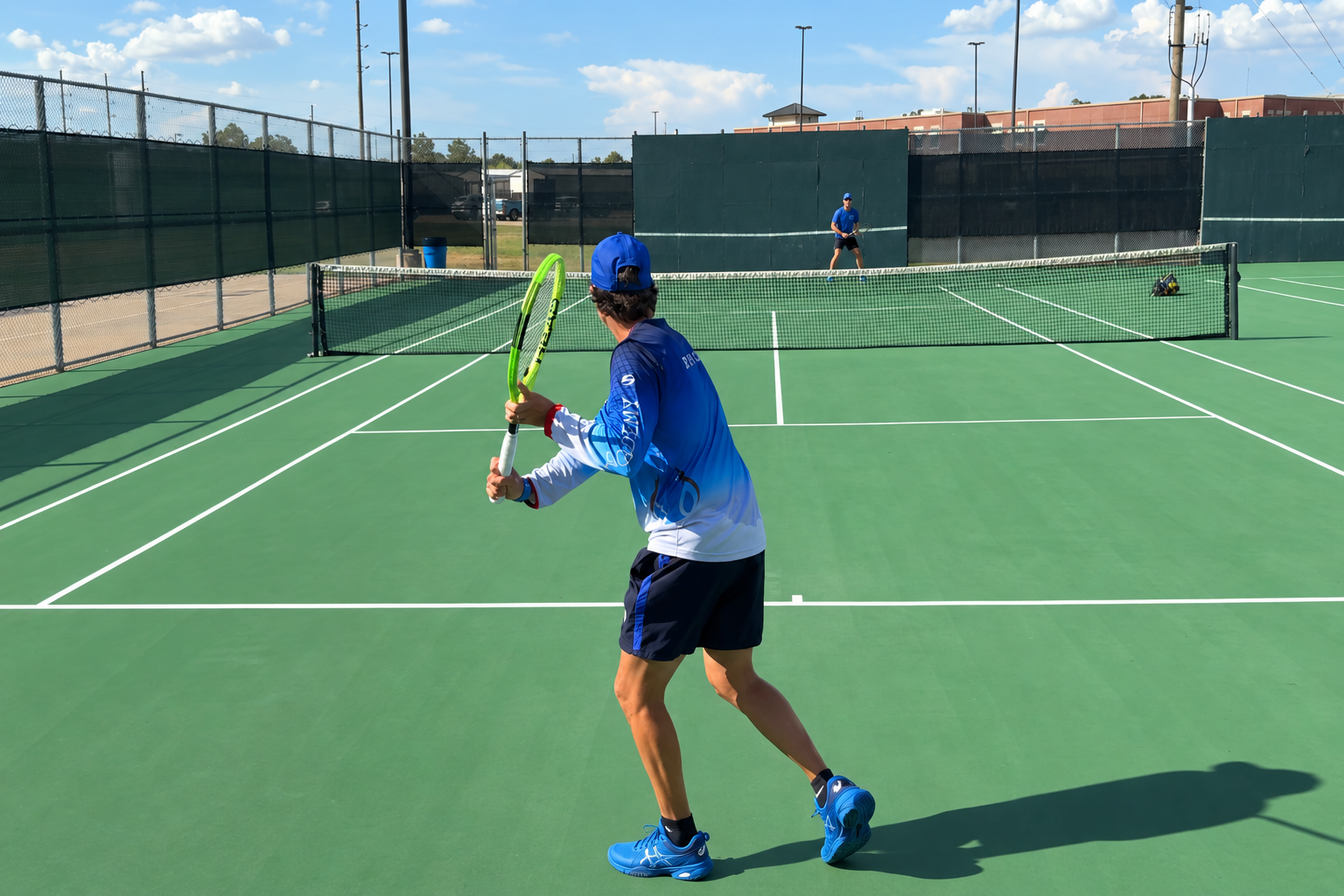
A one-handed backhand is a backhand where the player releases the non-dominant hand before the forward swing and hits the ball with only the dominant arm on the racquet. Most juniors use an eastern backhand grip, which allows them to hit both topspin and flatter shots while still being able to slice with a small grip adjustment. The stroke is typically played with a strong shoulder and hip rotation, a long arm, and an extended follow-through out toward the target and up over the shoulder.
Technically, the one-handed backhand demands:
Excellent timing and coordination to meet the ball with a stable racquet face.
Sufficient strength in the shoulder, forearm, and core to handle pace with one arm.
Strong footwork and spacing so the player can hit the ball in front of the body with a long reach.
What Is a Two-Handed Backhand?
A two-handed backhand uses both hands on the racquet throughout the swing. Most juniors place the dominant hand in a continental or eastern forehand position, and the non-dominant hand in a semi-western grip on top. This allows the non-dominant arm to drive the swing, creating stability and power from the legs, hips, and core through to the shoulders and hands.
Two-handed backhands are usually easier for younger players because:
Both arms share the load, so less raw strength is required in one shoulder and forearm.
The racquet is more stable at contact, which can reduce mishits and increase confidence under pressure.
The stroke feels similar to a two-handed swing in other sports (like baseball or softball), which many kids find natural.
Why the Two-Handed Backhand Is So Common in Junior Tennis
In modern junior tennis, especially at high-performance academies and USTA events, the two-handed backhand is the dominant choice. Research on junior technique and coaching trends highlights that younger athletes benefit from tools that increase stability, control, and repeatability as they learn to handle faster balls and heavier spin (Modern Techniques in Junior Tennis, TennisWorldUSA; Coaching the Junior Backhand, TennisCoach.com).
For many 8–14-year-olds, the two-handed backhand offers:
More forgiveness when the timing or spacing is slightly off.
Easier return of serve on faster first serves, where stability is critical.
Simpler progression from red/orange/green ball stages into full-court yellow ball tennis.
This does not mean the one-handed backhand is obsolete. It does mean that coaches in 2026 must be very intentional when recommending it to a developing junior, especially before the player has enough strength, coordination, and body awareness to execute it safely and effectively.
Potential Advantages and Challenges of the One-Handed Backhand
Advantages of the One-Handed Backhand
Reach and versatility: A long, extended arm gives extra reach on wide balls and allows seamless transition into slice, drop shots, and variety. This can be valuable on faster outdoor hard courts in Katy and Houston, where balls skid and stretch players wide.
Fluid movement into the net: Many players feel more natural transitioning from a one-handed backhand into approach shots and volleys, especially when using backhand slice to keep the ball low.
Shot variety and creativity: The one-handed backhand often makes it easier to disguise angles, spins, and trajectories, supporting an all-court, tactical style.
Challenges of the One-Handed Backhand for Juniors
Strength requirements: Handling heavy topspin and pace with one arm demands above-average strength in the shoulder, back, and core, which many younger players have not yet developed safely.
Tight timing window: The margin for error in contact point is smaller. Late contact often produces short, defensive balls or errors into the net or fence.
High technical demands: Without proper footwork, preparation, and spacing, the one-hander can break down under pressure, especially on fast, low-bouncing hard courts common in Texas.
Potential Advantages and Challenges of the Two-Handed Backhand
Advantages of the Two-Handed Backhand
Stability and control: Two hands on the racquet create a more stable hitting platform, helping juniors control direction and depth even when contact is not perfect.
Easier power generation: The non-dominant arm and torso rotation contribute significantly to power, allowing players with less upper-body strength to still hit a penetrating ball.
Return of serve advantage: On faster serves, the two-hander often feels more compact and secure, which is especially valuable in competitive junior matches where returns decide many points.
Challenges of the Two-Handed Backhand
Reduced reach: With both hands on the racquet, players may struggle to defend very wide balls, especially when pulled off the court on the backhand side.
More demanding on movement: Because reach is shorter, the player’s footwork and first step must be sharp to reach the ideal contact point consistently.
Transition to slice and net play: Some juniors find it harder to blend topspin, slice, and transition to the net if they have only trained a two-handed topspin backhand without complementary slice skills.
One-Handed vs. Two-Handed Backhand: Key Differences
The table below summarizes practical differences that parents and players in Katy and Greater Houston should understand when discussing junior tennis technique with a coach.
Aspect | One-Handed Backhand | Two-Handed Backhand |
|---|---|---|
Stability | Less stable under heavy pace; relies on strength and timing. | Very stable; two hands support the racquet at impact. |
Reach | Longer reach for wide balls and defensive shots. | Shorter reach; demands better positioning. |
Preparation | Requires early shoulder turn and precise spacing. | Can be slightly more compact; still needs early unit turn. |
Strength Requirements | Higher demands on shoulder, forearm, and core. | Shares load between arms and trunk; easier for younger players. |
Contact Point | Slightly farther in front and to the side of the body. | Closer to the body; compact contact zone. |
Return of Serve | More challenging on fast serves; timing window is smaller. | Often more reliable on heavy first serves. |
Movement Demands | Requires excellent balance and body control when stretched. | Requires quicker footwork to compensate for shorter reach. |
Development Considerations | Better suited once strength, coordination, and timing are advanced. | Often preferred in early and mid-junior stages for consistency. |
Why Your Child Should Not Copy a Favorite Professional’s Backhand
Many juniors in Katy and Houston want a one-handed backhand because they admire a professional player, or they insist on two hands because a top star uses it. While role models are inspiring, copying a pro’s stroke without context can lead to frustration or even injury. Elite players have:
Years of professional strength and conditioning.
Highly refined biomechanics and movement patterns.
Personalized coaching that matches their unique body type, mobility, and style.
A junior’s age, strength, coordination, reach, timing, mobility, and comfort must be considered first. The right backhand for your child may look very different from their favorite professional’s technique, and that is completely normal in high performance tennis development.
How Physical Development and Strength Influence Backhand Technique
Modern junior coaching philosophies emphasize long-term athlete development (LTAD), matching technique to each stage of growth (USTA LTAD guidelines). This is especially important for the backhand, where strength, coordination, and body size change rapidly between ages 9 and 16.
Before puberty, many players benefit from a two-handed backhand for stability while their muscles and joints are still developing.
As strength and coordination improve, some athletes may naturally transition toward a one-handed backhand or a stronger one-hand slice combined with a two-handed topspin backhand.
Growth spurts can temporarily affect timing, balance, and spacing, so coaches must be patient and avoid forcing major technical overhauls during these sensitive periods.
Preparation, Spacing, Balance, Footwork, Contact Point, and Recovery
Whether a junior uses a one-handed or two-handed backhand, the fundamental building blocks of a world-class stroke are the same:
Preparation: Early unit turn (shoulders and hips) and racquet preparation before the ball crosses the net set up both types of backhands for success.
Spacing: Getting the correct distance from the ball is critical. Too close or too far makes any backhand break down, no matter how talented the player is.
Balance and footwork: Quick adjustment steps, a solid base, and controlled body rotation allow players to swing freely without falling off the shot.
Contact point: Meeting the ball in front of the body with a stable racquet face is non-negotiable for both one-handed and two-handed backhands.
Recovery: Finishing the swing and returning quickly to a ready position prepares the player for the next ball, which is crucial in fast-paced junior rallies.
📌 Key Takeaway: Poor positioning and late preparation will make either backhand look weak. Often, the issue is not the number of hands on the racquet, but the quality of movement and spacing.
Why Coaches Should Evaluate the Complete Player Before Major Technical Changes
Changing a junior’s backhand from one hand to two hands, or vice versa, is a major technical decision. It affects not only stroke mechanics, but also tactics, confidence, and long-term development. A responsible coach in 2026 will evaluate the complete player, including:
Biomechanics and stroke production – how the body and racquet move through the swing.
Movement, footwork, and balance – can the player arrive in a strong hitting position consistently?
Coordination, timing, and rhythm – do they naturally sync the swing with the ball’s flight?
Strength and mobility – are their joints and muscles ready for the demands of a one-handed or two-handed stroke?
Tactical style – are they more of a baseliner, counterpuncher, or all-court player, and how does the backhand support that identity?
At ZENNIQ Academy in Katy, Texas, this type of individualized evaluation is a cornerstone of our player-development philosophy. We do not simply apply a generic stroke model. Instead, we analyze each athlete’s biomechanics, movement, and tactical profile before recommending any significant technical change.
When It May (or May Not) Make Sense to Change a Junior’s Backhand
Situations Where a Change May Make Sense
The player consistently struggles to handle pace or high balls on the backhand side, despite good footwork and preparation.
Their current technique limits tactical options, such as being unable to drive or redirect the ball under pressure at tournament level.
There are signs of chronic discomfort or overuse that may be related to poor mechanics or excessive strain on one arm.
Situations Where a Change May Not Be Necessary
The player’s backhand is effective in matches, even if it does not look like a textbook model on video or social media.
The desire to change is driven mainly by trends, rankings, or comparisons with other juniors, rather than clear technical limitations.
The player is in the middle of an important competition phase, where a major change could damage confidence and short-term performance.
💡 Pro Tip for Parents in Katy and Greater Houston: If your child is winning points with their current backhand and feels confident, ask their coach to focus first on footwork, spacing, and decision-making before considering a complete stroke change.
Why Technical Changes Require Time, Repetition, Match Play, and Progression
Switching from a one-handed to a two-handed backhand, or the reverse, is not a quick fix. It is a process that demands:
Time: The nervous system needs weeks and months of repetition to make a new movement pattern automatic, especially under pressure.
Repetition: Structured drills, basket feeding, and live-ball patterns are essential to engrain the new technique with correct tennis biomechanics and tennis footwork.
Match play: Players must gradually test the new backhand in practice sets and tournaments to learn how it behaves under real pressure, not only in drills.
Progression: A clear plan that moves from simple to complex, from controlled feeds to live points, prevents the player from feeling overwhelmed.
At ZENNIQ Academy, our small training groups and high-performance junior development programs in Katy, TX emphasize this kind of structured progression. We track measurable progress through video analysis, specific performance goals, and regular feedback, so families can see how technical changes translate into better on-court results.
Should My Child Change Their Backhand?
Parents often ask this question after watching professional tennis, scrolling through social media, or comparing their child’s results with other juniors in the Katy and Greater Houston area. It is important not to make a decision based solely on:
Trends in professional tennis or online coaching videos.
A favorite player’s one-handed or two-handed backhand.
Short-term rankings or tournament results.
Instead, an experienced coach should carefully evaluate your child’s:
Biomechanics – how efficiently they use their body to produce the stroke.
Movement and footwork – their ability to create space and arrive balanced to the ball.
Coordination and timing – how naturally they sync swing rhythm with ball timing on both sides.
Strength and mobility – current physical capacity and injury history, including shoulders, elbows, and wrists.
Balance and stability – ability to stay grounded through contact and recover quickly.
Tactical style and mindset – whether they naturally favor aggressive baseline play, counterpunching, or all-court patterns, and how the backhand supports that identity.
Within ZENNIQ Academy’s player-development philosophy, we combine individual technical correction, biomechanics, footwork, movement, balance, tactical development, and match play to decide if a backhand change is in the player’s best long-term interest. Our goal is not to create clones of a single model, but to build durable, efficient, and confident backhands that can succeed at higher levels of junior tennis and beyond.
FAQ: One-Handed vs. Two-Handed Backhand for Junior Players
Is a one-handed or two-handed backhand better for junior tennis players?
Neither stroke is universally “better.” For most younger juniors, two hands offer more stability and consistency while strength and coordination are still developing. As players mature, some will thrive with a one-handed backhand, others with a two-handed backhand, and some with a combination of two-handed topspin and one-handed slice. The best choice depends on age, strength, mobility, timing, and playing style.
At what age should a junior player develop a permanent backhand technique?
There is no exact age when a backhand becomes “permanent.” Generally, by the mid-teen years (around 14–16), the basic choice between one-handed and two-handed is clearer, as the player’s body type, strength, and tactical identity are more established. Before that, coaches should focus on solid fundamentals – grip, preparation, spacing, footwork, and contact point – and be open to adjustments as the player grows.
Is the one-handed backhand harder to learn?
For many juniors, yes. The one-handed backhand requires more precise timing and greater strength in one arm. That does not mean it is the wrong choice, but it does mean the learning curve can be steeper, and it may be more suitable once the player has reached a certain development stage and can maintain good balance, spacing, and body control.
Should my child switch from one hand to two hands?
A switch may be appropriate if your child’s current backhand is clearly limiting performance, causing discomfort, or not matching their physical profile and tactical goals. However, the decision should never be based only on trends, rankings, or social media. Work with an experienced coach who can assess biomechanics, movement, coordination, strength, timing, balance, and stroke production before committing to a change.
Can a junior player change their backhand later?
Yes. Many successful players have changed from one-handed to two-handed backhands (or vice versa) during their junior years. The key is to make the change with a clear plan, enough time and repetition, and support through match play and structured progression. Short-term results may dip during the transition, but with patient coaching, the new stroke can become a long-term asset.
What should a coach evaluate before changing a player’s technique?
A responsible coach will look at the full picture: biomechanics, movement, coordination, strength, timing, balance, stroke production, tactical style, and current technical development. At ZENNIQ Academy in Katy, Texas, we use video analysis, on-court testing, and small-group high performance training to make sure any technical change – including the backhand – supports the player’s long-term potential, not just a quick fix for the next tournament.
Bringing It All Together: ZENNIQ Academy’s Approach in Katy, Texas
For families searching for junior tennis Katy TX or a tennis academy in Katy, Texas, the question is not simply “one-handed or two-handed backhand?” The more important question is: “How can we give our child the best technical foundation for long-term success?”
At ZENNIQ Academy, our high performance tennis programs emphasize:
Individual technical correction for each player’s backhand – one-handed, two-handed, or a blend with slice – based on real tennis biomechanics and not just aesthetics.
Advanced focus on footwork, movement, and balance so that good strokes hold up under pressure on Houston-area hard courts and in tournament play across Texas.
Integrated tactical development and match play so juniors learn how and when to use their backhand – not just how to swing in a drill.
Small training groups that allow coaches to give detailed feedback, track measurable progress, and adjust training to each player’s development stage.
The one-handed backhand is not disappearing. The two-handed backhand is not the only modern option. In 2026 and beyond, the most successful junior players in Katy, Greater Houston, and around the world will be those whose backhands are matched to their bodies, minds, and playing identities – and refined through thoughtful, individualized coaching.