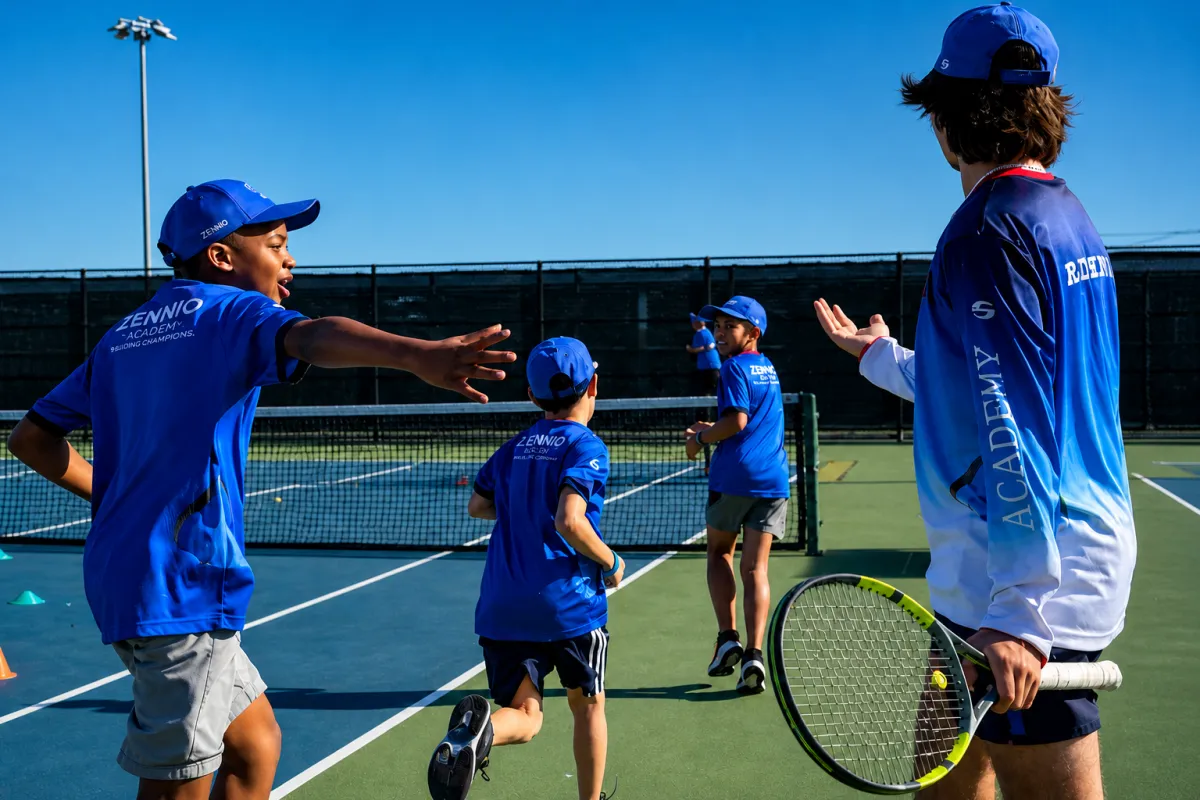
High Performance Tennis Training in Katy TX: Building Complete Junior Players
Modern tennis is not developed by simply hitting more balls. Repetition matters, but repetition without structure can create habits that are difficult to correct later. A complete player needs more than strokes. They need a clear mind under pressure, a body prepared for the demands of the game, reliable technical foundations, tactical awareness, discipline, and a training environment that helps them grow over time.
For families searching for high performance tennis training in Katy TX, Houston, or West Houston, the most important question is not only, “How many hours does my child train?” A better question is, “What kind of development system is guiding those hours?”
At Zenniq Academy, the philosophy of Practice | Focus | Perform reflects a complete approach to junior tennis development. Practice builds habits. Focus gives those habits direction. Performance tests them under pressure. When a player learns to connect the technical, physical, mental, and tactical parts of the game, training becomes more purposeful and progress becomes more sustainable.
Tennis Development Requires More Than Hitting Balls
Many young players can look impressive during a comfortable drill. They may hit clean forehands, rally from the middle of the court, or perform well when the ball arrives in the same place again and again. Competition is different.
In a match, the player must move, adjust, recover, choose targets, manage emotions, handle mistakes, read the opponent, serve under pressure, and compete when tired. This is why tennis development must be integrated. Technique, fitness, mindset, tactics, and structure need to work together.
The goal is not to promise instant results, rankings, scholarships, or a guaranteed pathway. Responsible development respects the player’s age, maturity, starting level, training frequency, attitude, and family commitment. The right system gives the athlete a better foundation for long-term growth.
Mental Toughness: Training The Mind Like A Skill
Mental toughness in tennis is not about pretending pressure does not exist. It is the ability to stay clear, composed, and competitive when pressure appears.
Junior players often lose points not because they lack talent, but because they lose focus after mistakes. A double fault, a missed forehand, a bad call, or a tight moment can quickly change body language and decision-making. The player who learns to reset has an advantage.
Mental training should include concentration, emotional control, resilience, routines between points, and positive body language. Players need to learn how to breathe, slow down, choose a target, commit to a pattern, and compete for the next point instead of replaying the last one.
This matters in USTA tournament preparation and in every competitive environment. A player can have strong technique in practice, but if the mind becomes reactive during matches, performance becomes inconsistent. The mind must be trained with the same seriousness as the forehand, backhand, serve, and footwork.
Physical Preparation: Tennis Fitness Is Specific
There is a difference between being active and being physically prepared to compete in tennis. Tennis requires repeated acceleration, deceleration, rotation, balance, recovery, and explosive movement in multiple directions.
Physical preparation for tennis should develop speed, agility, coordination, balance, functional strength, mobility, and tennis-specific endurance. A player must be able to move efficiently to the ball, recover after the shot, and maintain quality movement across long rallies and multiple matches.
Good physical training also supports injury prevention. When players improve strength, balance, movement mechanics, and recovery habits, they give their bodies a better chance to handle training volume. This is especially important for junior athletes, whose bodies are still developing.
Fitness should not be random conditioning added at the end of a lesson. It should be connected to the demands of tennis. Footwork patterns, core stability, shoulder health, lower-body strength, and recovery routines all play a role in helping a player train and compete more effectively.
Technique: Strong Fundamentals Create Freedom
Technique gives a player options. Without solid fundamentals, players often compensate with tension, late contact, poor balance, or inefficient mechanics. Over time, these habits can limit consistency and increase physical stress.
Technical development includes grip awareness, preparation, spacing, point of contact, timing, balance, swing path, recovery, and the ability to control direction, depth, height, and spin. The serve, forehand, backhand, volley, return, and movement patterns all need attention.
Good technique does not mean every player looks exactly the same. Players have different bodies, styles, and strengths. But the technical principles must support efficient movement, repeatable contact, and smart shot selection.
When technique is trained correctly, it helps players play with more confidence. They can build points instead of only reacting. They can make better decisions because their strokes are more reliable. They can also reduce unnecessary strain by using their body more efficiently.
Structure: The Difference Between Training And Improvising
One of the biggest differences between casual lessons and high performance tennis training is structure. A structured program begins with evaluation. Where is the player now? What are the strengths? What needs to improve? What level of competition is appropriate? What habits need to change?
From there, the player needs clear goals and a plan. Training should include technical priorities, physical development, tactical themes, mental routines, match play, feedback, and progress tracking. Without structure, lessons can feel productive in the moment but fail to build toward a larger objective.
Structure also helps parents. Families need honest communication about progress, expectations, training frequency, tournament readiness, and areas of responsibility outside the court. A responsible academy does not promise shortcuts. It helps players and parents understand the process.
Consistency is essential. One great session does not build a player. Development comes from repeated, focused work over time.
The Complete Player: Technique, Fitness, Mindset, And Tactics
A complete tennis player is not built from one ingredient. Technique without movement is limited. Fitness without tactical understanding becomes effort without direction. Mental toughness without technical skill can only go so far. Tactics without discipline break down under pressure.
The best development environments connect all parts of the game:
Technical foundations for reliable strokes.
Physical preparation for efficient movement.
Mental routines for pressure and resilience.
Tactical training for smarter point construction.
Competitive experiences that test progress.
A disciplined culture that values effort and accountability.
This kind of training is especially valuable for junior players in Katy, Houston, West Houston, Cinco Ranch, and Seven Lakes who want to prepare for more competitive tennis environments. Whether the goal is stronger fundamentals, tournament readiness, or a long-term college pathway discussion, the process should remain grounded, structured, and responsible.
What Parents Should Look For In A Tennis Development Program
Parents should look beyond surface-level intensity. A strong program should be able to explain how it evaluates players, how it plans training, how it communicates progress, and how it balances ambition with healthy development.
Important questions include:
Does the player have a clear development plan?
Are technical corrections specific and understandable?
Is physical training appropriate for age and level?
Are mental routines practiced, not just discussed?
Is tournament preparation realistic?
Are parents given honest guidance?
Does the environment encourage discipline, focus, and confidence?
The right program should challenge players while respecting the long-term process. Growth is not always linear. Players improve at different speeds depending on consistency, maturity, attitude, frequency, competition level, and support at home.
Practice | Focus | Perform
Practice is where habits are built. Focus is what gives those habits purpose. Perform is the test of preparation.
At Zenniq Academy, high performance tennis training is about helping players train with intention. The goal is to develop athletes who understand the game, respect the process, and learn how to compete with discipline.
No academy can guarantee wins, rankings, scholarships, or professional outcomes. What a serious training environment can provide is structure, professional coaching, clear standards, and a development pathway that helps each player work toward their potential.
For families in Katy, Houston, and West Houston looking for structured junior tennis development, the next step is simple: start with an evaluation, identify the player’s current level, and build a plan with purpose.
Final CTA
Schedule a player evaluation with Zenniq Academy and start with a structured development plan. Train with purpose. Practice | Focus | Perform.
FAQ
Why is mental toughness important in tennis?
Mental toughness helps players stay focused, manage pressure, recover from mistakes, and compete with emotional control. Tennis is a problem-solving sport, and the ability to reset between points is a major part of consistent performance.
How does physical training help junior tennis players?
Physical training helps junior players move more efficiently, improve speed and agility, develop balance and coordination, build functional strength, and reduce injury risk. Tennis fitness should match the real movement demands of the sport.
Why is technique important in tennis development?
Technique creates consistency, control, and long-term efficiency. Strong fundamentals help players make cleaner contact, control direction and depth, improve timing, and avoid unnecessary strain on the body.
What makes structured tennis training different?
Structured training is built around evaluation, goals, progress tracking, technical priorities, physical preparation, mental routines, and competitive development. It is a system, not a random collection of drills.
How often should junior players train?
Training frequency depends on age, level, goals, recovery, school schedule, and tournament calendar. Beginners may start with fewer sessions, while competitive players often need a more consistent weekly plan. The right schedule should be realistic and sustainable.
Can structured tennis training help with tournament preparation?
Yes. Tournament preparation can include point patterns, serve and return routines, match strategy, emotional control, recovery habits, and realistic competition planning. It does not guarantee results, but it helps players prepare more responsibly.